Latest Entries

I’ll park at the corner

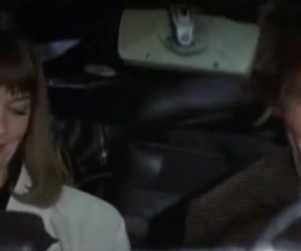
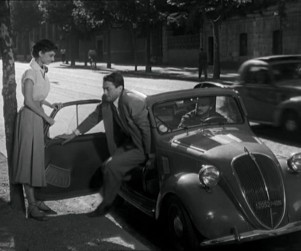
This is a scene of contrast and interaction between one of the tallest [191cm] actors and one of the tiniest cars. The Fiat “Topolino” 500 B Transformabile is so small that Joe [Gregory Peck] is able to open the door for Ann [Audrey Hepburn] from the back seat… through the convertible roof. But then, of course, he has some trouble stepping out. He was lucky, though, that the door opened the other way around as they do now.

William Wyler's "Roman Holiday" - Gregory Peck and Audrey Hepburn stepping out of a Fiat Topolino 500 B convertible car

New furniture… new life

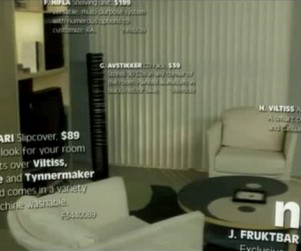
Midsommar Stories is an episodic film where “IKEA, myth of our time, is the linchpin for a series of different stories created by students in the department ‘Dramatic theory and script development’ of the University for Film and Television in Munich. Under the guidance of the German director Doris Dörrie the five best stories were developed.”
Here we present edited fragments of two of the stories: Sabotage by Andi Niessner and Markus Krämer, and Himmelbett (The Empty Bed) by Elena Alvarez.


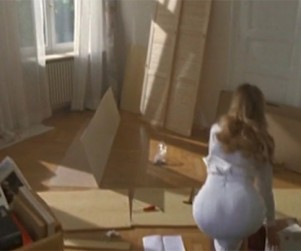
Midsommar Stories: "Sabotage" - IKEA Jalusie wardrobe assembly

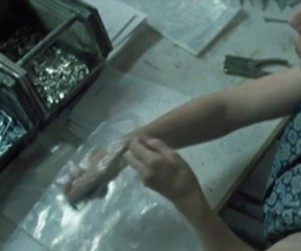
In the first short movie—Sabotage—we see Jacqueline as a worker in a factory in East Germany that produces furniture to be sold in West Germany IKEAs. After the reunification, helping a young man assembling one of the pieces she was working with, she becomes victim of one of her—deliberated—mistakes.

Midsommar Stories: "Sabotage" - IKEA Jalusie wardrobe factory and screw counting


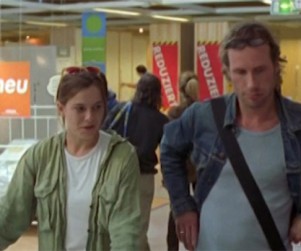
In the musical short Himmelbett (The Empty Bed), Lene wants to buy a new bed after a break up, so Peter and his girlfriend take her to IKEA.

Girlfriend — Why are we going to IKEA?
Peter — When people split up, they go to IKEA.
GF — I thought when you move in with somebody.
P — No, then you’d have everything double. When you split up, there is nothing left, so you buy everything new. IKEA is the land of new beginnings. New furniture… new life.

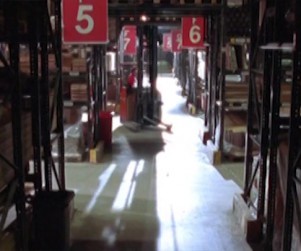
In the movie, in addition to the bed department, we also get to see the distribution and storage corridors, one of the distinctive characteristics of IKEA shops, as a set for dancing forklifts.

Midsommar Stories: "Himmelbett" - IKEA storage system

I’m more of a… collector, really


Everything is illuminated - The collector Safran Foer's family keepsakes

In his very interesting book The System of Objects, Jean Baudrillard included a chapter called “A Marginal System: Collecting”. He wrote:

Among the various meanings of the French word objet, the Littré dictionary gives this: ‘Anything which is the cause or subject of a passion. Figuratively and most typically: the loved object’. It ought to be obvious that the objects that occupy our daily lives are in fact objects of a passion, that of personal possession, whose quotient of invested affect is in no way inferior to that of any other variety of human passion.
[...]
The object pure and simple, divested of its function, abstracted from any practical context, takes on a strictly subjective status. Now its destiny is to be collected. Whereupon it ceases to be a carpet, a table, a compass, or a knick-knack, and instead turns into an ‘object’ or a ‘piece’.1

Everything is illuminated - The collector Safran Foer grandparents' objects

In the movie—based on Jonathan Safran Foer’s novel Everything Is Illuminated—, during his ‘very rigid search’ for the woman that saved his grandfather’s life, the main character, named Jonathan Safran Foer, shows several times how and why a collector acts.
When asked about why he keeps on collecting keepsakes, Jonathan answers: “Because sometimes I’m afraid I’ll forget”. As Terry Shoptaugh writes in his essay “Why Do We Like Old Things? Some Ruminations on History and Memory“:

All of these things serve a similar function of reminding us of a particular time and place. As such, they can help the ordinary person encompass a sense of the past. [...] When we look at something that stimulates our memory, we are setting up a link between past and present. [...] Keepsakes can be crucial to this process, by serving as ‘triggers’ to stimulate memory.2

Everything Is Illuminated has a dreamy feeling that links perfectly with this sentence by Jean Baudrillard: “just as the function of dreams is to ensure the continuity of sleep, objects ensure the continuity of life”3

» original source / transcription / credits

This is the type of furniture we should be making


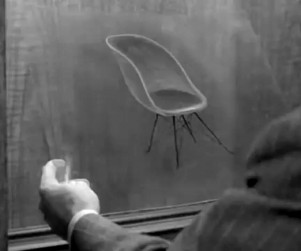
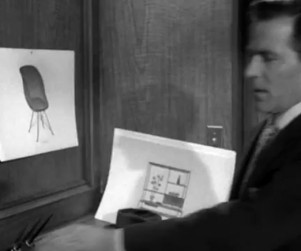
As a young designer in a classical furniture company, Harold Skinner tries to update the catalog by improving the aesthetics and using new materials.
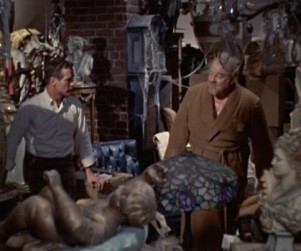
When he discovers the radical opposition of John Brown, the company owner, Harold approaches Brown’s wife to start a—Hitchcock typically perverse—partnership in order to launch his designs. Another example of a designer trying to improve a company through design that uses the Eames—and their Molded Plastic chairs—as a reference.

Alfred Hitchcock Presents "John Brown's Body" - Modern vs. classical furniture: chair and sofa

» original source / transcription / credits

That’s the trouble with too much comfort

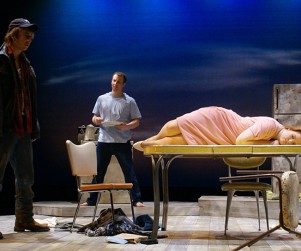
Sam Shepard - "Curse Of The Starving Class" - Image: ©2011 University of North Dakota Department of Theatre Arts

ella: Oh, knock it off, would you? I’m exhausted.

weston: Try the table. Nice and hard. It’ll do wonders for you.

ella: (Suddenly soft) The table?

weston: Yeah. Just stretch yourself out. You’ll be amazed. Better than any bed.

(ella looks at the table for a second, then starts pushing all the clean laundry off it onto the floor. She pulls herself up onto it and stretches out on it. weston goes on cooking with his back to her. She watches him as she lies there.)

weston: And when you wake up I’ll have a big breakfast of ham and eggs, ready and waiting. You’ll feel like a million bucks. You’ll wonder why you spent all those years in bed, once you feel that table. That table will deliver you.

[...]

weston: That’s the trouble with too much comfort, you know? Makes you forget where you come from. Makes you lose touch. You think you’re making headway but you’re losing all the time. You’re falling behind more and more. You’re going into a trance that you’ll never come back from. You’re being hypnotized. Your body’s being mesmerized. You go into a coma. That’s why you need a hard table once in a while to bring you back. A good hard table to bring you back to life.

[act iii]

In the midst of Curse Of The Starving Class, one of Sam Shepard’s family plays, a man metaphorically offers her wife a hard table to rest on.

» original source / transcription / credits

What if we stand up?

Chairs—not even Coca-Cola chairs—doesn’t really control people. If anything, they condition them and their surroundings.
This Coca-Cola campaign (created by Publicis Spain) against overweight and sedentary lifestyle, in some way claims that the problem is”the consumer’s fault for sitting down so much“, and the director chose to illustrate it showing all kinds of chairs are around the world being bereft of their function.

Coca-Cola "Chairs" Campaign: conference room, church, office, asia street seats, stadium, sofa armchair, meeting room, university, metro train, india street seats, classroom, office.

» original source / transcription / credits

The car of tomorrow… today

The story of the Tucker ’48 automobile is one of the most colorful in the history of motor cars Its creation began in the bright light which awakened mankind from the darkness of World War II.
A lone individual with a passion for improving automotive deisgn gathered a following for a remarkable enterprise. He was not famous to begin with, and is now hardly known at all, yet during the brief period of this saga, his intense belief in his goals attracted and inspired thousand of people.
He was Preston Thomas Tucker, an unlettered engineer intimately acquainted with some of the great names in automotive history. From singularly modest beginnings, he developed his experience into credentials for success, rising to unusual heights.
This is the story of the designing of his dream car, an automobile that proudly joins the ranks of advanced design concepts of automotive history; a car that still fascinates the public forty years later.1

This is the beginning of the introduction1 that Philip S. Egan wrote about Tucker and his car, which he helped designing. The story is about The Man And The Car: Tucker was a real entrepreneur, and The Car That Tucker Built was a real gem for that time.2
The movie shows the design process of the car, lead by Preston Tucker (Jeff Bridges), from the early drawings until the working prototype.

Jeff Bridges as Preston Tucker - Rear engine sketches

Preston Tucker, Alex Tremulis and others - Tucker car design process in movie - Blueprint, aerodynamics, prototype

Preston Tucker factory in Francis Ford Coppola movie

The car had a wide advertisement impact, announcing the Tucker Torpedo (that would later become the Tucker ’48) as the result of “How fifteen years of testing produced the first completely new car in fifty years.”

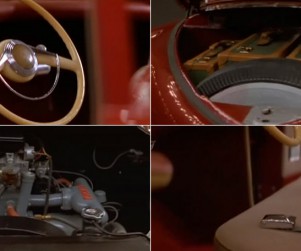
Tucker 48 - Coppola movie - Wheel, engine, trunk, seat belts

Tucker Torpedo vintage advertisement in Francis Ford Coppola movie Tucker

The add was no longer for a “Torpedo” but simply the “Tucker ’48.” It was somewhat different from the “Torpedo” of a few months before, a bit more conservative.
[...] Within a matter of months, two generations of Tucker automobiles had been presented to the public as fait accompli. The differences in the two advertised Tucker designs were pivotal. [George Lawson and Alex S. Tremulis,] the men responsible for the two generations of the car – which didn’t yet exist – were both highly qualified automotive designers. As I looked over the two difference advertisements, I suspected the divergence of opinion which the two designs represented indicated that Preston Tucker might still be in the process of deciding what the Tucker automobile would finally look like. This proved to be a valid surmise.
3

In the Tucker ’48 brochure we can read a few of many new engineering features—rear engine, Tucker ignition, precision balance, individual wheel suspension, frame lower than center line of wheels—and safety features—windshield, steel bulkheads, frame surrounding passenger compartment, cyclops eye, crash board and safety chamber.4

Jeff Bridges as Preston Tucker during safety presentation

The car briefing was so complex that two design teams were needed: Alex Tremulis’ team as members of the Tucker Corporation and Lippincott Associates for the styling of several parts5. The As it is understadable because of the complexity of the plot, we have to point out that the movie doesn’t reflect this collaboration between teams, but it does show the problems with outside engineering teams (not reflected in P.S. Egan’s book).
Tucker had not only problems with the engineering of the car, but with the whole automotive industry.

Abe – You made the car too good.
Tucker – Well, that’s the whole idea, isn’t it? To build a better mousetrap.
Abe – Not if you’re the mouse.

But against all odds, the car was finally presented:

The sleepless night stretched into morning as last minute preparations continued. The crowds arrived, some 5,000 strong, all impatient to see the car. The Goose at last seemed ready, but Stampli’s pessimism should have been more expansive. The huge Tucker 589 engine had finally been assembled, but testing had barely begun. The specimen engine in the prototype had been run only briefly. When started up it gave out a roar loud enough to raise the dead. Time was pressing hard now, the throng in the improvised auditorium was becoming restless; the show had to go on regardless of the noisy engine.
Tucker ordered the band to play its loudest and to keep the sound level up as the prototype was rolled up to the presentation area and mounted the stage behind the twelve-food courtains. But the music could not cover a new problem. As the engine warmed up, its coolant flowed to the front-mounted radiators and started to boil over.
No one was in any mood to hesitate any longer. Steam or no steam, it was time to go ahead. Gene Haustein, the Tucker test driver, climbed in, and set the transmission lever to “go.” The courtains parted, and the Tin Goose came onto center stage. No one noticed the problems. The Tucker ’48 Tin Goose prototype was gorgeous. Haustein shut the engine down as soon as the car reached center stage, and the crowd, all 5,000, rose to its feet and reared its approval!6

Jeff Bridges as Preston Tucker during the 1947 Tucker car presentation - Fiction-reality comparison

“The Tucker ’48 should present a striking image as it approached and a dramatic impression as it passed.”7 With this two views, the movie ends:

Although only fifty Tuckers were ever produced, forty six of them are still road worthy and in use today. Tucker's innovations of aerodynamic styling, padded dash, pop out windows, seat belts, fuel injection and disc brakes were slowly adopted by Detroit and are found in the cars you are driving now.Preston Tucker died of an illness six years after the trial, but his ideas will live forever.

Although only fifty Tuckers were ever produced, forty six of them are still road worthy and in use today. Tucker’s innovations of aerodynamic styling, padded dash, pop out windows, seat belts, fuel injection and disc brakes were slowly adopted by Detroit and are found in the cars you are driving now.
Preston Tucker died of an illness six years after the trial, but his ideas will live forever.

» original source / transcription / credits

You don’t like this bed, I show you another one

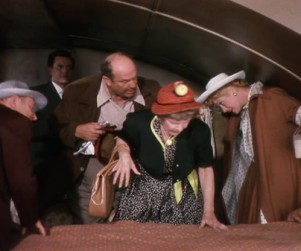
The Marx Brothers are surprised sleeping in the bed department of The Big Store, so they just pretend to be salesmen, showing the customers all kinds of beds: a davenport sofa that elevates to display bunk beds, a bookcase that can be turned into a bed, a bank safe bed—a safe place to keep the kids— or a foldout tent that appears from a trunk of a car drawn in the wall. All of them activated by push-buttons from a control panel…

Told by Design - Marx Brothers - The Big Store - Davenport sofa elevates to display bunk beds

Told by Design - Marx Brothers - The Big Store - Bookcase turning into bed

Told by Design - Marx Brothers - The Big Store - Bank safe bed - Harpo at the controls

Told by Design - Marx Brothers - The Big Store - Asian family activates a car trunk that holds foldout tent bed

In the very last scene of the clip, Groucho goes to bed like having in mind this Thomas Hood verses from Miss Kilmansegg and her precious leg; a golden legend (1870):

Oh bed! oh bed! delicious bed!
That heaven upon earth to the weary head;

Told by Design - Marx Brothers - The Big Store - Groucho engulfed by a "Do not disturb door" folding bed

Groucho quoted them in his book Beds (first published in 1930), where he doesn’t write about beds as objects—well, he does, too—but mostly about situations in life with beds involved:

I sleep now in a very sophisticated bed, with lots of buttons to raise head and feet. As I’ve never been good at mechanics, I spend many nights sleeping in a 45 degrees angle. Sometimes, in the middle of the night, I dial a combination that folds me in three, just like a Playboy centerfold.*

» original source / transcription / credits

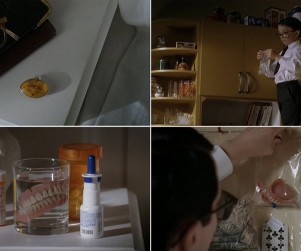
A very satanic-looking little old table

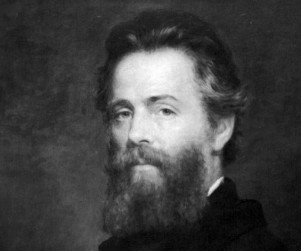
Told by Design - Herman Melville - The Apple-Tree Table

When I first saw the table, dingy and dusty, in the furthest corner of the old hopper-shaped garret, and set out with broken, be-crusted old purple vials and flasks, and a ghostly, dismantled old quarto, it seemed just such a necromantic little old table as might have belonged to Friar Bacon. Two plain features it had, significant of conjurations and charms—the circle and tripod—the slab being round, supported by a twisted little pillar, which, about a foot from the bottom, sprawled out into three crooked legs, terminating in three cloven feet. A very satanic-looking little old table, indeed.
In order to convey a better idea of it, some account may as well be given of the place it came from. A very old garret of a very old house in an old-fashioned quarter of one of the oldest towns in America. [...]

This is the beginning of a short story about a wicked table, subtitled “Original Spiritual Manifestations”. After describing his way up to the garret—and the garret itself—the narrator finally discovers the table:

[...] I turned inward to behold the garret, now unwontedly lit up. Such humped masses of obsolete furniture. An old escritoire, from whose pigeonholes sprang mice, and from whose secret drawers came subterranean squeakings, as from chipmunks’ holes in the woods; and broken-down old chairs, with strange carvings which seemed fit to seat a conclave of conjurors. And a rusty, iron-bound chest, lidless, and packed full of mildewed old documents; one of which, with a faded red inkblot at the end, looked as if it might have been the original bond that Doctor Faust gave to Mephistopheles. And, finally, in the least lighted corner of all, where was a profuse litter of indescribable old rubbish—among which was a broken telescope, and a celestial globe staved in—stood the little old table, one hoofed foot, like that of the Evil One, dimly revealed through the cobwebs. What a thick dust, half paste, had settled upon the old vials and flasks; how their once liquid contents had caked, and how strangely looked the mouldy old book in the middle—Cotton Mather’s Magnalia.
Table and book I removed below, and had the dislocations of the one and the tatters of the other repaired. I resolved to surround this sad little hermit of a table, so long banished from genial neighbourhood, with all the kindly influences of warm urns, warm fires and warm hearts; little dreaming what all this warm nursing would hatch.
I was pleased by the discovery that the table was not of the ordinary mahogany, but of apple-tree wood, which age had darkened nearly to walnut. It struck me as being quite an appropriate piece of furniture for our cedar-parlour—so called, from its being, after the old fashion, wainscoted with that wood. The table’s round slab, or orb, was so contrived as to be readily changed from a horizontal to a perpendicular position, so that, when not in use, it could be placed snugly in a corner. For myself, wife and two daughters, I thought it would make a nice little breakfast and tea-table. It was just the thing for a whist table, too. And I also pleased myself with the idea that it would make a famous reading-table.
In these fancies, my wife, for one, took little interest. She disrelished the idea of so unfashionable and indigent-looking a stranger as the table intruding into the polished society of more prosperous furniture. But when, after seeking its fortune at the cabinet-maker’s, the table came home, varnished over, bright as a guinea, no one exceeded my wife in a gracious reception of it. It was advanced to an honourable position in the cedar-parlour.

The renewed table doesn’t have only a central part in the parlour, but also in the story, as it is the main character and focus of the whole narration.

» original source / transcription / credits

A full line of field and kitchenware


Oskar Schindler (Liam Neeson) opened the Deutsche Emalwarenfabrik Oskar Schindler (German Enamelware Factory Oskar Schindler) in Kraków during the Holocaust, employing jews—part of his famous list— to manufacture enamelware.
Spielberg’s movie illustrates the training of this workers on how a soup pot was made.

Steven Spielberg - Schindler's List - German Enamelware Factory - Soup pot manufacturing

Later on the movie, we see Rabbi Levertov (Ezra Dagan) making a hinge in the Plaszow forced labour camp metalworks factory—also run by Schindler—, under the gaze of Amon Göth (Ralp Fiennes), commander of the camp.

Steven Spielberg - Schindlers' List - Plaszow forced labour camp metal factory - Rabbi Levertov - Hinge manufacturing

» original source / transcription / credits


Hosted by Guim Espelt i Estopà. 2011-2013. All © extracts cited in this blog belong to its authors. For more information click here.

RSS Feed. This is a WordPress powered blog, using Rodrigo Galidez's Modern Clix theme adapted by guimworks.